
South Fulton Is Atlanta’s Hottest Rental Market: 7.3% Rent Growth and What Investors Should Do About It
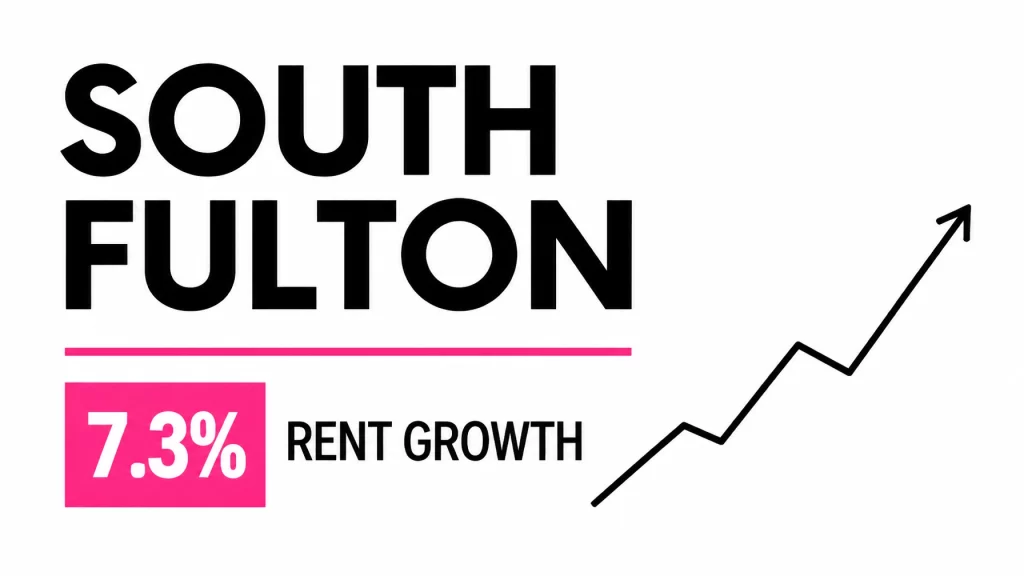
South Fulton led all Atlanta multifamily submarkets with 7.3% year-over-year rent growth in Q2 2026. The result places South Fulton ahead of Douglasville and West Atlanta suburbs at 3.7%, Buckhead and Midtown Atlanta at 2.7%, and Downtown Atlanta at 2.4%.
The result is significant. It is also incomplete without the vacancy data.
South Fulton recorded 6.2% multifamily vacancy in Q2 2026. The metro Atlanta vacancy rate was 5.86%, down from 6.45% in Q1. New lease-ups are filling vacant units, but the submarket continues to carry more available inventory than the metro average.
For investors evaluating an investment property for sale, South Fulton offers a combination of rent growth, employment access, infrastructure investment, and acquisition flexibility. It also requires conservative underwriting.
South Fulton Rental Market Data: What the 7.3% Means
The 7.3% figure comes from Q2 2026 Atlanta multifamily market data tracking professionally managed apartment properties. It reflects year-over-year growth in effective rents, including the impact of new leases and lease-up performance.
The broader Atlanta multifamily market recorded:
- Average effective rent of approximately $1,594.
- Year-over-year rent growth of 0.18%.
- Net absorption of 5,984 units.
- Metro vacancy of 5.86%.
- South Fulton vacancy of 6.2%.
- Q2 deliveries of 2,703 units.
- Approximately 16,243 units under construction.
The submarket-level result is stronger than the metro result because South Fulton is still absorbing recently delivered properties. New lease-ups began with vacant units. As occupancy increased, effective rents moved higher.
The data should not be confused with advertised single-family rental data. Realtor.com reported a South Fulton median rent of approximately $1,800 per month in August 2026, with rental inventory and asking rents moving differently from professionally managed multifamily assets. The South Fulton market data also reported a median listing price of approximately $291,200.
This distinction is material. A 7.3% increase in effective multifamily rents does not mean every single-family rental owner can increase rent by 7.3%. Asset type, location, unit condition, lease expiration, and competing inventory remain decisive.

Why South Fulton Is Outperforming Atlanta
1. Hartsfield-Jackson supports a large employment base
South Fulton benefits from proximity to Hartsfield-Jackson Atlanta International Airport. The airport supports approximately 63,000 to 64,000 on-site jobs and generates approximately $34.8 billion in annual economic impact for metro Atlanta, according to regional airport and economic development materials.
Airport employment creates demand across multiple income levels. The workforce includes aviation, security, concessions, ground handling, maintenance, transportation, hospitality, logistics, and administrative positions.
South Fulton is positioned within the airport-adjacent employment belt. Residents can access the airport, industrial corridors, and central Atlanta employment centers without paying the housing costs commonly associated with intown locations.
The result is consistent demand for workforce housing. Apartments and single-family rentals priced below the metro median can serve employees seeking access to airport-related employment while managing transportation and housing costs.
2. Industrial expansion is creating additional rental demand
South Fulton is receiving major logistics, warehouse, manufacturing, and fulfillment investments.
Notable projects include:
- Project MAPCO, a proposed 1.6 million-square-foot logistics and light manufacturing campus with up to 2,000 jobs.
- Amazon’s Campbellton Road fulfillment operation, involving approximately 1.1 million square feet and an estimated 750 new full-time jobs.
- SoFu Commerce Center, a planned 213,580-square-foot industrial facility with approximately 150 permanent jobs.
- Post Consumer Brands’ Fairburn expansion, adding approximately 301,320 square feet and new employment.
- Additional industrial, distribution, cold storage, and data center proposals across the South Fulton development pipeline.
These projects do not create identical housing demand. A warehouse employee, airport worker, supervisor, and corporate manager will not search for the same unit. The combined effect is still important. Employment diversification supports a broader tenant base than a submarket dependent on one employer or one industry.
Industrial investment also increases demand for nearby services, transportation, retail, maintenance, and food-service employment. Rental demand can therefore expand beyond the direct headcount announced for each project.
3. Public infrastructure is supporting the growth corridor
South Fulton and Fulton County are investing in roads, sidewalks, lighting, public safety, water, and sewer capacity.
Relevant projects and programs include:
- More than $150 million in reported transportation projects during FY2024.
- Approximately $25 million in FY2025 TSPLOST 2 transportation funding.
- Sidewalk improvements along Old National Highway.
- Upgrades to industrial corridors, including Oakley Industrial Boulevard.
- Major public safety facilities near Old National Highway and Jonesboro Road.
- Fulton County water and sewer capital investment supporting future development.
- Airport and county facility improvements under broader capital programs.
Infrastructure does not automatically create rent growth. It improves the operating environment that allows jobs, housing, and commercial activity to expand.
Investors should focus on properties near corridors receiving measurable investment. Campbellton Road, Old National Highway, Fairburn, airport-access routes, and industrial employment areas warrant separate analysis. The relevant question is not whether South Fulton is receiving infrastructure funding. The relevant question is whether the subject property benefits from the specific improvement.

What Investors Should Watch
South Fulton vacancy remains elevated at 6.2%
The 6.2% submarket vacancy rate exceeds the metro Atlanta rate of 5.86%. This indicates that rent growth is occurring alongside available inventory.
That combination requires disciplined lease-up analysis. A property can report strong effective rent growth while still carrying concessions, vacant units, or elevated marketing costs.
Underwriting should include:
- Stabilized vacancy.
- Lease-up vacancy.
- Free-rent concessions.
- Renewal conversion rates.
- Tenant turnover.
- Leasing commissions.
- Make-ready expenses.
- Competitive deliveries.
- Property-specific occupancy.
The vacancy rate also explains why investors should not pay solely for historical rent growth. South Fulton may be outperforming because properties are moving from lease-up to stabilization. That growth rate may moderate after occupancy normalizes.
Asking rents have pulled back from the 2025 peak
Broader listing data indicates that advertised rents have pulled back from recent highs. Realtor.com reported a median South Fulton rent of approximately $1,800 per month, with month-over-month rent movement declining and longer-term rental pricing below prior levels.
This is not necessarily inconsistent with the 7.3% multifamily result. The datasets measure different properties and different rent concepts:
- Effective multifamily rents measure operating performance in professionally managed apartment assets.
- Advertised rental data includes single-family homes, apartments, townhomes, and other rental listings.
- New lease data can differ from renewal data.
- Concessions can reduce effective rent without changing the advertised asking rent.
- A market can show positive rent growth in one segment and declining asking rents in another.
Investors should compare the subject property with direct competitors rather than relying on one headline number.
New supply remains a local risk
South Fulton continues to attract development. Industrial growth can support rental demand, but new housing supply can increase competition.
Properties near major development should be evaluated for:
- Delivery timing.
- Unit count.
- Rent positioning.
- Amenities.
- Parking availability.
- Employer proximity.
- Single-family versus multifamily competition.
- Planned build-to-rent communities.
Supply is not automatically negative. New housing can expand the tenant pool and improve local amenities. It can also force older properties to offer concessions or fund improvements.
Practical Investor Strategies for South Fulton
Target the $250,000 to $400,000 price tier
The $250,000 to $400,000 acquisition range can provide access to South Fulton’s workforce housing demand while avoiding the higher basis associated with premium Atlanta submarkets.
Potential targets include:
- Existing single-family rentals.
- Townhomes with confirmed rental permissions.
- Smaller multifamily properties.
- Properties requiring controlled cosmetic improvements.
- Homes near airport-access routes and employment corridors.
- Properties with layouts suitable for long-term tenants.
The price tier should not be treated as a substitute for property-level analysis. Taxes, insurance, maintenance, financing, and vacancy can materially change the result.
A viable acquisition should be tested using current rent comparables, not projected rent growth alone.
Underwrite Georgia’s three-business-day notice requirement
The Georgia Safe at Home Act affects residential lease agreements entered into or renewed on or after July 1, 2024.
For covered leases, a landlord generally must provide a written notice giving the tenant at least three business days to pay amounts due or vacate before filing a dispossessory action based on nonpayment. Weekends and recognized court holidays are excluded from the calculation. Notice delivery and documentation requirements must also be followed.
Investors should account for this requirement in:
- Delinquency assumptions.
- Legal expense reserves.
- Collection timelines.
- Property management procedures.
- Notice templates.
- Lease administration.
- Cash reserves.
The requirement does not eliminate the ability to pursue nonpayment cases. It establishes a required pre-filing process. Self-help lockouts and utility shutoffs create legal risk.
The Georgia landlord-tenant law resource published by GPC Real Estate provides additional information regarding habitability, deposits, notices, and nonresident ownership structures. Legal questions should be reviewed with a Georgia-licensed attorney.
Compare build-to-rent with scattered-site single-family rentals
South Fulton is suitable for both build-to-rent and scattered-site single-family strategies. The correct structure depends on capital, operating capacity, and the target tenant profile.
Build-to-rent advantages may include:
- Centralized property management.
- Consistent construction standards.
- Shared amenities.
- More efficient maintenance.
- Stronger community branding.
- Easier leasing and renewal administration.
Build-to-rent risks may include:
- Higher development costs.
- Lease-up exposure.
- Construction delays.
- Competition from nearby communities.
- Greater concentration risk.
- Financing and exit risk.
Scattered-site advantages may include:
- Lower initial scale.
- Existing rental income.
- Multiple neighborhood locations.
- Flexibility in acquisition timing.
- Potential value creation through renovation.
- Broader exit options.
Scattered-site risks may include:
- Longer maintenance routes.
- Inconsistent property condition.
- Higher coordination costs.
- Varied local competition.
- Individual repair events.
- Greater management complexity.

Investors seeking scale and centralized operations may prefer build-to-rent. Investors prioritizing flexibility and phased acquisitions may prefer scattered-site properties. Neither strategy removes vacancy, legal, financing, or maintenance risk.
South Fulton Investment Checklist
Before acquiring a South Fulton rental property, investors should verify:
- Current rent comparables by property type and floor plan.
- Actual vacancy and concessions at competing properties.
- Distance to airport, industrial, and public-sector employment.
- Road and infrastructure projects affecting access.
- Planned multifamily and build-to-rent deliveries.
- Property taxes and insurance costs.
- Repair requirements and capital reserves.
- Homeowners association rental restrictions.
- Georgia lease compliance requirements.
- Three-business-day notice procedures for covered leases.
- Property management response times.
- Exit value under flat-rent and higher-vacancy scenarios.
GPC Real Estate’s investment process evaluates acquisition, funding, repairs, and long-term rental or resale positioning. The process should be applied to both individual properties and larger portfolio strategies.
Conclusion
South Fulton is Atlanta’s strongest multifamily rent-growth submarket in Q2 2026, with 7.3% year-over-year rent growth. Airport employment, industrial expansion, workforce housing demand, and public infrastructure investment support the submarket’s performance.
The risk profile remains active. Vacancy is elevated at 6.2%, broader advertised rental data shows a pullback from the 2025 peak, and additional development may increase competition.
The strongest strategy is not to assume that every South Fulton property will produce 7.3% rent growth. It is to acquire at a defensible basis, target the $250,000 to $400,000 price tier, underwrite conservative vacancy, comply with Georgia law, and select an operating model suited to the asset.
Investors evaluating an investment property for sale in Atlanta can review additional investor education resources or contact GPC Real Estate for property-specific analysis.
This article is provided for general educational purposes. It is not legal, tax, lending, or investment advice. Georgia investors should consult qualified legal, tax, lending, and real estate professionals before completing a transaction.
Sources
