
The Georgia Eviction Process in 2026: A Step-by-Step Guide for Atlanta Landlords
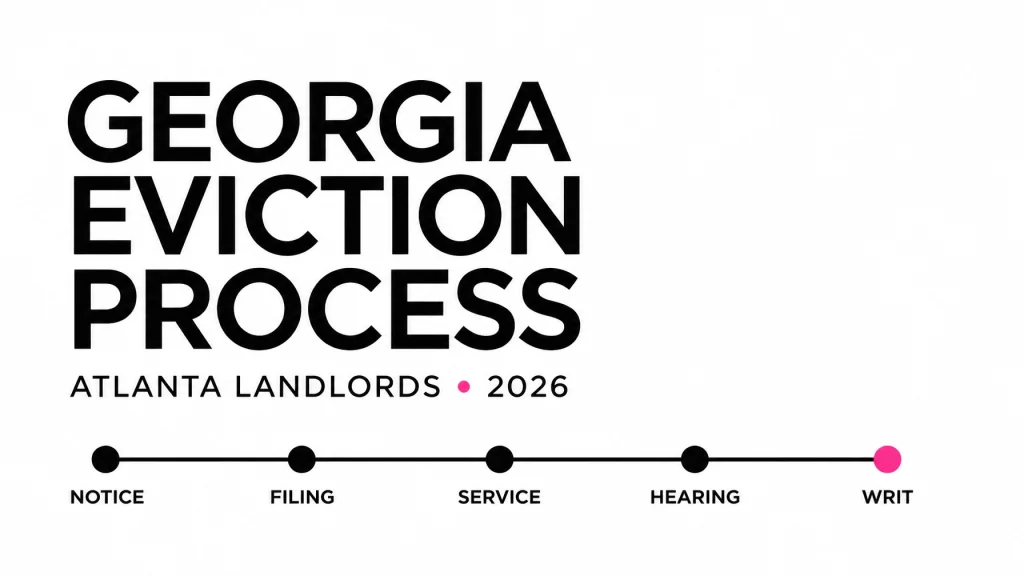
Georgia residential evictions are handled through a court action called a dispossessory proceeding. Atlanta landlords and investors cannot remove a tenant through a lockout, utility shutoff, or personal property removal.
The process generally follows this order:
- Review the lease and establish the legal basis for removal.
- Provide the required demand or notice.
- File a dispossessory affidavit in the county where the property is located.
- Serve the tenant through an authorized process.
- Allow the tenant seven days to answer.
- Attend a hearing if an answer is filed.
- Obtain a judgment and writ of possession.
- Coordinate physical removal through the marshal or sheriff.
The following guide summarizes the Georgia real estate law and process applicable to Atlanta residential landlords in 2026.
Step 1: Confirm the Legal Basis Before Filing
A landlord must identify the reason for seeking possession. Common grounds include:
- Nonpayment of rent or lease-authorized charges
- Expiration or termination of a fixed-term lease
- Holdover after a required termination notice
- Material violation of the lease
- Serious misconduct or property damage
The written lease should be reviewed before any notice is issued. The lease may establish payment procedures, notice methods, cure periods, renewal terms, and termination requirements.
A tenant who remains after a fixed-term lease expires may not always be treated as an immediate holdover. If the landlord permits the tenant to remain and accepts rent, a tenancy at will may be created. Georgia generally requires 60 days’ notice from a landlord to terminate a tenancy at will.
Nonpayment cases follow a separate notice procedure. A landlord should not use the 60-day tenancy-at-will rule as a substitute for the nonpayment process.
Step 2: Provide the Required Demand or Notice
Demand for possession
Georgia law requires a landlord to demand possession before filing a dispossessory action. The demand must communicate that the landlord requires the tenant to surrender the property.
A written demand is recommended even when an oral demand may be legally sufficient. The record should identify:
- Tenant name
- Property address and unit number
- Reason for seeking possession
- Required action
- Date of delivery
- Delivery method
The demand should match the lease and the facts supporting the case. Inconsistent or incomplete notices can create defenses and delay the proceeding.
Three-business-day notice for nonpayment
For covered residential leases entered into or renewed on or after July 1, 2024, Georgia law requires written notice before filing a dispossessory action based on nonpayment.
The tenant must be given at least three business days to pay the rent and applicable fees or vacate. The notice should state:
- The rental property
- The amount claimed
- The basis for the amount
- The payment deadline
- The method for making payment
The notice must be delivered through a method allowed by the lease or by posting it in a sealed envelope on the tenant’s door. Additional delivery methods may be required by the lease.
The landlord should retain the notice, a payment ledger, delivery records, and any communication concerning payment. The filing date should be calculated only after the required three-business-day period has ended.

Step 3: File a Dispossessory Affidavit
If the tenant does not pay, vacate, or correct the applicable violation, the landlord may file a dispossessory action.
The action is usually filed in the magistrate court of the county where the rental property is located. Most Atlanta properties are located in Fulton County, but properties in DeKalb, Cobb, Clayton, Gwinnett, and other counties must be filed in the applicable county court.
The Fulton County Clerk’s dispossessory page provides county-specific information for landlord-tenant cases.
The landlord, agent, or attorney files a sworn affidavit. The affidavit generally identifies:
- The landlord or legal owner
- The tenant or tenants
- The complete property address
- The grounds for possession
- The demand for possession
- The tenant’s refusal or failure to surrender possession
- The amount of rent or other charges claimed
- Compliance with the three-business-day notice requirement, when applicable
The property address must be complete and accurate. It should include the street number, direction, street name, apartment, suite, room number, and ZIP code when applicable.
A filing fee is required. Fees and filing procedures vary by county. Current requirements should be confirmed with the applicable clerk before filing.
Step 4: Complete Legal Service
After filing, the tenant must receive the summons and dispossessory affidavit.
The landlord cannot serve the papers personally. Service is completed by the marshal, sheriff, or an authorized private process server.
Permitted service may include:
- Personal delivery to the tenant
- Delivery to a competent adult resident
- Tack and mail service when personal service is unsuccessful and the legal requirements are satisfied
The Fulton County Marshal’s Department states that the dispossessory must contain the correct and complete address before service can occur. Address errors can prevent service or require corrective action.
The Fulton County Marshal’s Department eviction instructions explain the local sequence for filing, service, writ processing, scheduling, and execution.
Investors should maintain the return of service in the property file. The service date controls the tenant’s answer deadline.
Step 5: Allow Seven Days for the Tenant to Answer
The tenant generally has seven days after service to file an answer. If the seventh day falls on a Saturday, Sunday, or legal holiday, the deadline moves to the next day that is not a Saturday, Sunday, or legal holiday.
The answer may raise defenses or counterclaims. Common issues include:
- Rent was paid
- The amount claimed is incorrect
- The required notice was not provided
- Service was defective
- The lease was not properly terminated
- The landlord failed to maintain habitable conditions
- The action is retaliatory or discriminatory
If no answer is filed, the landlord may request a default judgment and then apply for a writ of possession. A hearing may not be required.
Tender defense in nonpayment cases
In a nonpayment case, a tenant may be able to prevent eviction by paying all rent and applicable fees claimed in the dispossessory, plus court costs, within the seven-day answer period.
This tender defense is generally available only once during a 12-month period with the same landlord. Investors should not assume that a partial payment resolves the case. Payment records and written confirmation should be maintained.
If an answer is filed, the case may proceed to a hearing. If the case is not resolved within approximately two weeks after service, the court may require rent to be paid into court as it becomes due.
Step 6: Attend the Hearing and Present the File
A tenant answer usually results in a court hearing. The scheduling period varies by county and court volume. No single statewide hearing date applies to every Atlanta case.
The landlord or authorized representative should bring:
- The signed lease and amendments
- Payment ledger
- Notices and demands
- Proof of delivery
- Photographs
- Inspection records
- Repair records
- Relevant tenant communications
- Evidence supporting the claimed balance
The evidence should establish the landlord’s right to possession and the tenant’s wrongful possession. The landlord should address the specific legal basis stated in the affidavit.
A judgment may award:
- Possession of the property
- Past-due rent
- Lease-authorized fees
- Court costs
- Other amounts allowed by the court
If the tenant prevails, the case may be dismissed and no writ of possession will issue.
Step 7: Apply for the Writ of Possession
A judgment for the landlord does not authorize the landlord to remove the tenant independently. A separate writ of possession must be requested from the clerk.
The writ is the court order authorizing the marshal or sheriff to restore possession to the landlord.
In Fulton County, the landlord or agent may apply for the writ after the seven-day answer period expires without an answer or after the time specified by the judge following a hearing. The clerk processes the writ and sends it to the marshal’s department for execution.
The Georgia Department of Community Affairs Landlord-Tenant Handbook states that the writ generally requires the tenant to move after seven days. Specific procedures can vary based on the court order and local practice.

Step 8: Coordinate the Physical Eviction
The marshal or sheriff controls the physical set-out. A landlord cannot perform the initial entry or remove the tenant without law enforcement supervision.
In Fulton County, the marshal’s department contacts the landlord or agent to schedule the eviction. The landlord must arrange labor or an eviction company. Fulton County states that five or more able-bodied people are usually required to complete an eviction efficiently.
The landlord, agent, or moving crew should be present at the scheduled time. The marshal makes the initial entry. The tenant’s property must be removed in accordance with the officer’s instructions and applicable law.
If the tenant pays, vacates, or otherwise resolves the matter before execution, the landlord should notify the assigned deputy immediately. The marshal’s department schedules writs based on its operating procedures and receipt order.
Common Compliance Pitfalls for Atlanta Investors
Filing before the notice period expires
A premature filing can result from calculating business days incorrectly or filing before the three-business-day nonpayment period ends.
Using an incorrect property address
An incomplete address can prevent service. Unit, suite, room, direction, and ZIP code information should match the lease and the physical premises.
Failing to document delivery
A copy of the notice is not the same as proof of service. Delivery records should identify the date, method, recipient, and supporting documentation.
Using self-help measures
Changing locks, removing doors, shutting off utilities, blocking access, or moving personal property without a writ and marshal or sheriff involvement can create liability.
Ignoring retaliation and fair housing rules
An eviction filed soon after a tenant requests repairs or reports a code issue may create a retaliation claim. An action based on a protected characteristic or a protected accommodation request can create additional exposure.
Claiming unsupported charges
The affidavit should state a current and supportable balance. Rent ledgers should distinguish rent, late fees, utilities, repairs, and other charges. Unsupported amounts can weaken the possession claim or create a dispute over damages.
Investor Education Takeaways
The Georgia eviction process affects underwriting, reserves, property management, and operating performance. Investors should account for:
- Notice and court processing time
- Legal and filing costs
- Marshal or sheriff scheduling
- Labor and property removal costs
- Unit repairs after possession is restored
- Releasing and vacancy costs
- Potential delays from contested cases
A standardized compliance file should be created for every property. The file should contain the lease, notices, payment records, inspection reports, maintenance records, court documents, and possession records.
The GPC Investment Process includes property evaluation, repairs, financing, and long-term rental positioning. Legal operating requirements should be reviewed during acquisition and management planning. Additional investor education is available through GPC Real Estate.
This article provides general educational information about the Georgia eviction process. It is not legal advice. Atlanta landlords should consult a Georgia-licensed attorney regarding notices, lease violations, contested dispossessory actions, writs of possession, retaliation concerns, and county-specific procedures.
