
Georgia Foreclosures Are Up 52% in 2026: Where Atlanta Investors Actually Find the Discounts
Market data current as of October 18, 2026.
What the foreclosure increase means
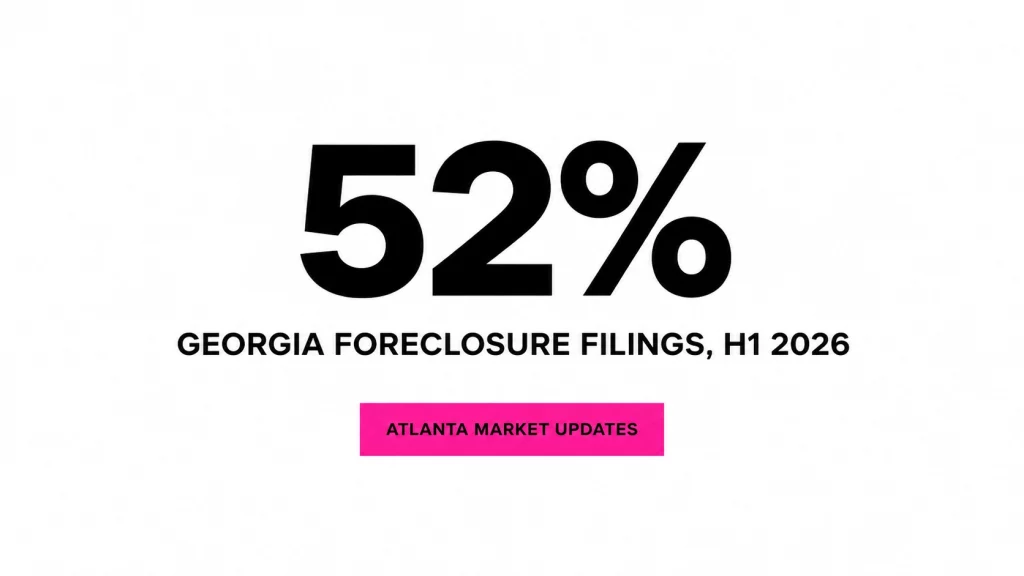
ATTOM recorded 227,548 U.S. properties with foreclosure filings in the first half of 2026, up 21 percent year over year. Georgia recorded 8,433 filings, up 52 percent. Among states with at least 500 filings, Georgia had the third-largest annual increase, behind Idaho and Colorado.
Foreclosure filings and foreclosure starts are separate measures. ATTOM counted 8,164 Georgia foreclosure starts in the first half, up 23.3 percent from 6,259 a year earlier. Georgia ranked fourth nationally by starts, behind Texas, Florida and California.
In the first quarter, Georgia recorded 4,356 starts. Its filing rate was one in every 998 housing units, compared with one in every 1,211 nationally. Atlanta accounted for 2,520 starts, about 58 percent of the state total. Atlanta ranked among the five U.S. metros with the largest numbers of starts, alongside New York, Houston, Chicago and Dallas.
In August, Georgia ranked fifth nationally with 1,189 starts. The state’s foreclosure rate was one in every 3,576 housing units. The rate and the total number of starts measure different things. Neither establishes the likely discount on a specific property.
The ATTOM mid-year report provides the national and state-level filing and start data. The ATTOM first-quarter report provides quarterly figures.
Atlanta conditions support negotiation beyond auctions
Foreclosure volume is one part of the current Atlanta market. In the 12-county Georgia MLS region, September sales totaled 4,072, down 13.7 percent year over year. Pending sales were 3,436, down 24.8 percent and marking the ninth consecutive monthly decline. Active listings reached 23,006, up 5.3 percent and a decade high. The median sales price was approximately $399,900.

The September Georgia MLS report describes slower market activity and increased buyer choice. Freddie Mac’s average 30-year fixed rate was 7.40 percent on October 8, compared with 6.30 percent a year earlier. The Freddie Mac rate archive reports national averages. Individual loan terms vary.
City-level data also show room for negotiation. Atlanta’s September median sale price was $385,000, with an average 67 days to sell, compared with 61 days a year earlier. Of 7,579 active listings, 1,687 had price reductions. That is about 22 percent of active listings. The Atlanta pricing report identifies price reductions and extended market time as observable seller signals.
These conditions create alternatives to courthouse auctions. Investors can assess reduced-price listings, stale inventory, failed transactions, vacant homes and properties requiring repairs. The GPC Atlanta market trends update provides additional local context.
Where Atlanta investors find discounts
Pre-foreclosure owners. Owners who are behind on payments but have not received the required sale notice may have time to consider a private sale. The process can resemble a standard motivated-seller transaction and may take months. Payoff amount, equity, title and the owner’s authority to sell must be verified.
Published foreclosure notices. Once a sale date appears in a county legal organ, the timeline is shorter. Georgia requires public advertising once a week for four consecutive weeks before the sale. Speed to the first informed conversation matters. Competition often clusters around notices in Fulton, DeKalb, Gwinnett, Cobb and Clayton counties.
Bank-owned properties. Not every scheduled auction results in a sale to an outside bidder. Properties that become real estate owned, or REO, may later be marketed by lenders. Atlanta recorded 213 bank repossessions in April 2025 and 52 in April 2026, the steepest annual decline among large metros. Macon declined from 26 to 14. The figures show that more foreclosure starts do not necessarily produce more bank-owned inventory at the same time.
Open-market listings. Price reductions, long listing periods, failed contracts and deferred maintenance can create negotiating leverage without the timing and title risks of an auction. A discount should be supported by comparable sales, repair estimates, transaction costs and a clear exit plan.
Macon had one of the highest metro foreclosure rates in the first half of 2026, at 0.36 percent of housing units. That rate measures foreclosure activity, not investment return. It should not replace property-level analysis.
For a property acquired through assignment, the buyer should confirm contract rights and disclosures before closing. GPC’s guide to Wholesale Real Estate 101 and Georgia assignment deals explains the basic transaction structure. The company’s investment process outlines acquisition, funding, renovation and exit planning.
Georgia foreclosure law and auction requirements
Georgia generally permits nonjudicial foreclosure under a power of sale. Under OCGA 44-14-162.2, the lender must send the debtor written notice at least 30 days before the sale by certified or registered mail, or statutory overnight delivery. The notice must identify a contact with authority to negotiate the loan.
Under OCGA 44-14-162 and OCGA 9-13-141, sales generally occur on the first Tuesday of the month, from 10 a.m. to 4 p.m., at the county courthouse. The sale must be advertised once a week for four consecutive weeks in the county legal organ.
A winning bidder must tender the full bid immediately in cash or certified funds. There is no standard deposit period and no financing contingency. A bid should not be made unless the required funds are available.
Georgia provides no general statutory post-sale redemption period for the former owner. A federal tax lien is a significant exception. Under 26 U.S.C. 7425(d), the IRS may have a 120-day redemption right, generally with six percent annual interest, when the statutory conditions apply.
A foreclosure deed under power is not a warranty deed. Auction buyers should budget for a title search before bidding and may need a quiet title action before resale or refinancing. Junior lienholders may have priority to surplus sale proceeds before any remainder is paid to the former owner under OCGA 13-4-42. A lender seeking a deficiency judgment must file a confirmation action in Superior Court within 30 days. A judge must find that the sale brought true market value under OCGA 44-14-161.
Practical screening steps
Before pursuing an investment property for sale through foreclosure or a private seller, investors should:
- Confirm the sale notice, county and deadline.
- Verify ownership, liens, taxes, bankruptcy status and payoff information.
- Review title before bidding and estimate any title-curing costs.
- Estimate repairs, carrying costs, resale value or achievable rent.
- Confirm available funds and the required payment method.
- Compare the auction opportunity with reduced-price and off-market properties.
Rising foreclosure starts alongside falling repossessions indicate that some owners may exit the foreclosure pipeline through reinstatement, loan modification, postponed sales or private sales. The figures do not identify how many owners use each option. They do show why investors should monitor both notices and completed outcomes.
Georgia foreclosure data can identify areas for further research. They do not guarantee below-market acquisition prices. A discount is established only after title, condition, financing, costs and exit value have been reviewed.
For further investor education, see GPC’s educational resources and its overview of Georgia landlord-tenant law.
This article is for general information only and is not legal or financial advice. Data is drawn from third-party sources, including ATTOM, Georgia MLS and Freddie Mac. Definitions, reporting periods and estimates may differ. All figures and legal requirements should be independently verified with the relevant data provider, county office, lender, title professional or Georgia attorney.
