
Chattooga County Rental Investing in 2026: A $216,500 Discount, Four Sales a Month, and Why Thin Data Demands Different Diligence
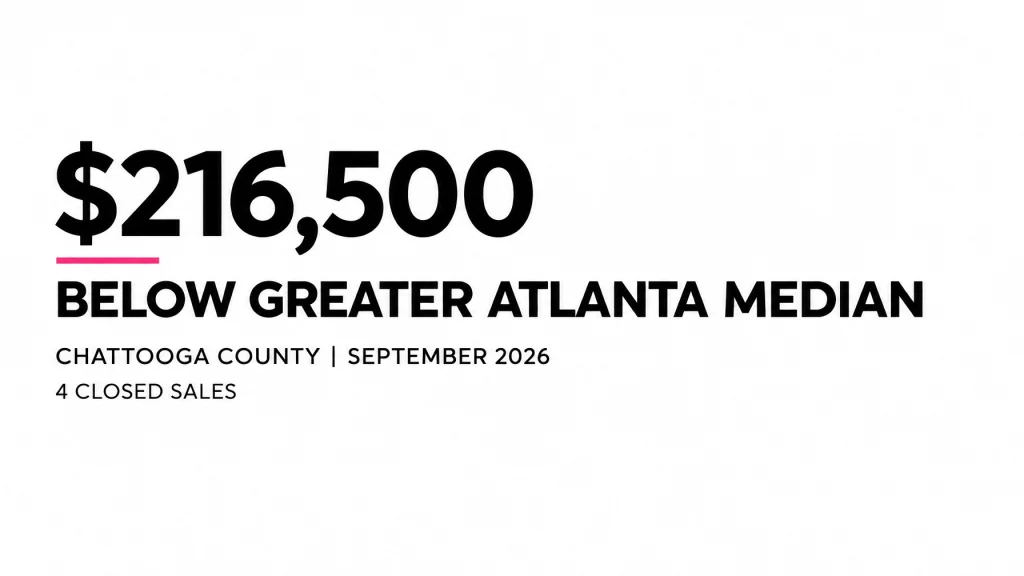
Chattooga County, in far northwest Georgia, presents an investment case that cannot be assessed from a county median alone. The September 2026 median sale price was $216,500 below the Greater Atlanta median. Yet only four homes closed in the county that month. Small transaction counts make monthly medians volatile and limit their usefulness for pricing an individual investment property for sale.
For Atlanta-based investors, the relevant question is not whether the headline gap signals a bargain. It is whether a specific property can support verified rent, operating costs, and a realistic resale plan in a thin market.
Chattooga County real estate market trends: September 2026 benchmark
The verified benchmark is the Simply List report using FMLS InfoSparks data by ShowingTime Plus. The report was published October 15, 2026, and its source data is dated October 15, 2026. It reports a median sale price of $198,500, up 7.3% year over year. The report notes that the county median was $216,500 below the Greater Atlanta median for the same month.
| FMLS measure | September 2026 | Year-over-year change |
|---|---|---|
| Median sale price | $198,500 | +7.3% |
| Closed sales | 4 | -42.9% |
| Pending sales | 4 | +33.3% |
| New listings | 8 | -38.5% |
| Homes for sale | 27 | +8.0% |
| Cumulative days on market | 110 | +39.2% |
| Months of supply | 6.9 | +1.5% |
| Sale-to-original-price ratio | 84.6% | -9.6% |
| Median price per square foot | $135 | -8.8% |
Source: Simply List, Chattooga County Housing Market Report: September 2026, published October 15, 2026; source data dated October 15, 2026. FMLS calculates months of supply using month-end active inventory and average monthly pending sales over the trailing 12 months. Statistics may be revised by the source.

The price-to-original-price ratio and time on market indicate room for negotiation at the county level. They do not establish the appropriate offer for a specific home. The FMLS report also states that the county and Greater Atlanta comparison reflects different mixes of homes sold. It does not mean the same property would sell for more or less solely because of its county.
Why the reported price direction differs by source
Other published data show year-over-year declines. AM 1180/WZQZ reported that Realtor.com’s August 2026 median sold price was $170,000, down 8.1% year over year. Redfin data through July 2026 showed a three-month median sale price of approximately $165,000, down nearly 10% from the same period one year earlier.
These figures do not match the September FMLS direction. They cover different periods and come from different sources with different methodologies. They should not be combined as if they measured the same set of transactions.
The small number of FMLS closings is a central limitation. With four closed sales in September, a different mix of homes can move the median substantially. A single unusual property may affect the monthly midpoint more than a broad change in underlying values. The September median is a benchmark, not proof of a sustained price trend.
For broader Atlanta market updates, comparisons with metro statistics should therefore be treated as context rather than direct valuation evidence.
Rental demand signals and affordability constraints
The local housing context provides a separate reason to investigate rental demand. AM 1180/WZQZ reported on September 8, 2026, that the county’s 2026 Comprehensive Plan estimated approximately 24% of county households were housing-cost burdened, meaning they spent at least 30% of income on housing. The article cited Census median household income of approximately $50,000.
The same report stated that Realtor.com showed one county rental listing in August 2026, located in Trion. That is evidence of thin publicly marketed inventory, not proof that only one rental was available. Local rentals may be advertised privately, through property managers, social media, or word of mouth.
The Census Bureau’s 2020–2024 multi-year estimate for median gross rent was $790 per month, as reported by AM 1180/WZQZ on September 8, 2026. HUD’s 2026 two-bedroom Fair Market Rent estimate for ZIP codes 30747 and 30753 is approximately $970 per month. HUD defines FMR as a rent benchmark for program administration. It is not a forecast of achievable rent for a particular house. RentCafe does not publish a usable average for these towns because listings are limited.

These data establish affordability pressure and limited visible listings. They do not confirm market rent, tenant depth, or lease-up time for an individual property. Rent estimates should be checked directly with local rental managers and recent comparable leases. Investors should distinguish Summerville, Trion, Menlo, Lyerly, and rural locations rather than assume countywide uniformity.
AM 1180/WZQZ reported that Mohawk Industries in Summerville and JBAR Manufacturing in Trion were hiring during 2026. Employment activity may inform local tenant research, but a job announcement does not establish the number of renters, income levels, or rent capacity for a particular unit.
Chattooga Ridge adds supply and a demand signal
The Chattooga Ridge development near Trion is a relevant housing indicator. AM 1180/WZQZ reported on September 8, 2026, that Piedmont Housing Group and Georgia DCA were advancing a 44-unit family apartment community at 14624 U.S. Highway 27. The planned mix includes one-, two-, and three-bedroom apartments.
The project received an annual $1.215 million federal Low-Income Housing Tax Credit allocation through Georgia’s competitive program. The report stated that 11 of 44 units received a preliminary commitment through Georgia DCA’s Place-Based Voucher program. The state documentation cited in the article does not indicate that all 44 apartments will be Section 8 units. The Chamber described the project as workforce housing.
The development is evidence that housing providers see a need for rental units. It is also future supply that may compete with some rental properties. Its affordable structure means it should not be treated as a direct market-rent comparable for an unsubsidized single-family home. Investors should verify the project’s delivery and leasing status before incorporating it into a property-level forecast.
For voucher-related investor education, review GPC’s Section 8 rental investing guide. Voucher program rules and payment standards must be confirmed with the administering agency for the property location.
Summerville Rural Zone: a commercial and mixed-use consideration
Summerville’s Rural Zone designation took effect January 1, 2026, and applies to its downtown business district. It is a potential niche consideration for business operators and commercial or mixed-use investors. It is not an automatic incentive attached to purchasing a rental house.
Georgia DCA’s Rural Zones program page describes credits for qualified activities in designated areas. Under the provided program terms, an eligible business must create at least two new full-time equivalent jobs. Credits include a $2,000 annual Job Tax Credit per new FTE job for up to five years, capped at $40,000 per year; an Investment Credit of 25% of a property purchase price, capped at $125,000 and prorated over three years; and a Rehabilitation Credit of 30% of qualified rehabilitation expenditures, capped at $150,000 and prorated over three years.
Credits may be layered, but they cannot be combined with other state tax credit programs. DCA certification and program eligibility rules apply. The Summerville Rural Zone announcement provides local designation context. Any prospective applicant should confirm boundaries and requirements with DCA and a qualified tax professional. The Georgia DOR Form IT-RZ should also be reviewed for current filing instructions.

Taxes, exit liquidity, and property-level diligence
Tax costs require parcel- and jurisdiction-specific review. AM 1180/WZQZ reported that Chattooga County’s 2026 maintenance and operations millage rate was set at its rollback rate of 7.959 mills, and the school district’s net M&O rate was 8.5180 mills, also adopted at rollback. A separate November 1, 2026, report stated that Trion had tentatively proposed a 10.781-mill rate, above its 10.495-mill rollback rate, with public hearings scheduled through November 12, 2026. The proposal was not final as of the report date.
The county was also seeking more than $2 million in homeowner relief pending state approval, according to AM 1180/WZQZ on October 5, 2026. On September 29, 2026, the outlet reported a property tax rollback of nearly $933,000 credited to new sales tax revenue. Those reports do not guarantee an investor’s tax bill or future relief. Georgia assesses property at 40% of fair market value; parcel-specific tax estimates should be confirmed with the Chattooga County Tax Commissioner.
Exit liquidity also requires conservative assumptions. The September FMLS figures of 6.9 months of supply and 110 cumulative days on market indicate that resale may take longer than in a more active market. A county median cannot resolve this risk.
Before making an offer, investors should:
- Obtain direct rent checks from local managers and verified comparable leases.
- Separate rent evidence by town, property type, size, and condition.
- Confirm parcel taxes, utilities, insurance, maintenance needs, and rent-ready costs.
- Review comparable sales and competing active listings for the specific property.
- Model longer marketing and vacancy periods than in a high-volume metro market.
- Compare self-management requirements with professional management costs using GPC’s property manager break-even analysis.
Additional operational references include GPC’s Georgia tenant-screening guide, Georgia landlord insurance guide, and Q4 2026 Atlanta rental outlook.
Investment conclusion
Chattooga County’s $216,500 gap below the Greater Atlanta median is a comparison, not a valuation or ranking. Four September closings, conflicting reported price directions, thin advertised rental inventory, and limited rent benchmarks require more property-level verification than a typical county-average analysis.
The relevant investment education lesson is direct: confirm rent and expenses locally, evaluate the specific town and property, and include longer exit timelines. The county’s median and advertised listing count are starting points for diligence, not substitutes for it.
This article is for general educational purposes only. It is not legal, tax, lending, or investment advice. Market data may be revised and may use different reporting periods and methodologies. Verify all figures and property-specific assumptions with the relevant sources and qualified professionals before making a decision.
