
Seller Concessions on Atlanta Investment Property: The 2% Conventional Cap and What a Credit Really Covers in 2026
SEO title: Seller Concessions on Atlanta Investment Property: The 2% Conventional Cap in 2026
Meta description: Learn how the conventional investment-property concession cap works, which Georgia closing costs a seller credit may cover, and how to document it.
URL slug: /seller-concessions-atlanta-investment-property-2-percent-cap-2026
Category: Investor Education
Reviewed: November 14, 2026
Sales across metro Atlanta are closing below original list prices on average. A seller credit can address eligible buyer closing costs without changing the agreed contract price, but conventional investment-property loans limit financing concessions to 2% of the lower of the sale price or appraised value. The credit also cannot exceed the buyer’s actual eligible costs.
How much are Atlanta sellers negotiating below list price?
In October 2026, the Greater Atlanta sale-to-original-list-price ratio was 0.950, which indicates that the typical sale closed about 5% below the original list price. This is a measure of negotiation behavior, not a forecast or evidence about an individual property. Greater Atlanta months of supply was 5.0, up from 4.4 in October 2025. Both figures come from FMLS October 2026 market statistics.
A lower price and a closing-cost credit serve different purposes. A price reduction lowers the contract price. An eligible, documented credit can keep the agreed price intact while reducing certain settlement expenses. The lender and appraiser still need to review the transaction and its concessions.
In four of GPC Real Estate’s confirmed buying areas, reported October sale-to-original-list ratios were 0.946 in DeKalb, 0.952 in Clayton, 0.955 in Cobb, and 0.958 in Gwinnett. As an interpretation, lower ratios can indicate greater seller movement in a county’s sales. They do not establish that a specific seller will accept a credit or that a particular property is correctly priced. County data can also move with small sample sizes.
For a broader review of local market conditions, see GPC Real Estate’s Atlanta market trends for October 2026.
What is the conventional concession cap for an investment property?
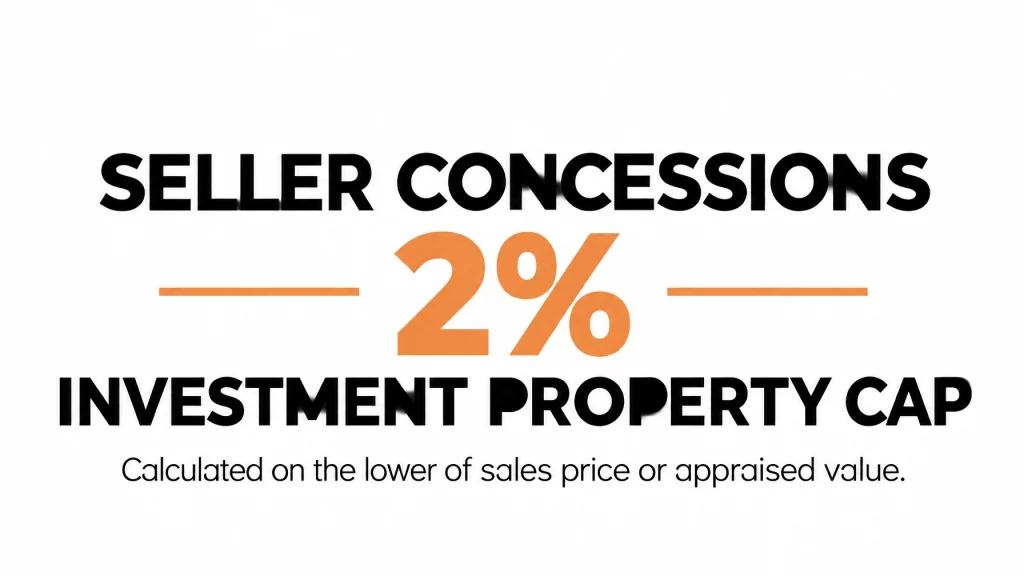
Under Fannie Mae’s Selling Guide B3-4.1-02, financing concessions on an investment property are limited to 2% at all LTV and CLTV ratios. The percentage is calculated on the lower of the sales price or appraised value, not on the loan amount.
| Occupancy type | LTV/CLTV tier | Maximum financing concession |
|---|---|---|
| Investment property | All ratios | 2% |
| Principal residence or second home | More than 90% | 3% |
| Principal residence or second home | 75.01% to 90% | 6% |
| Principal residence or second home | 75% or less | 9% |
The owner-occupied and second-home limits are comparison points. They do not change the investment-property cap.
Hypothetical calculation: If the contract price and appraised value are both $300,000, 2% of the lower figure is $6,000. If the contract price is $300,000 but the appraisal is $285,000, the calculation uses the appraisal: 2% of $285,000 is $5,700.
The cap is only one limit. The financing concession also must not exceed the borrower’s actual closing costs. A credit above the cap or above eligible costs is treated as a sales concession under the guide.
What happens if a seller credit exceeds the cap?
Fannie Mae treats financing concessions above the applicable cap as sales concessions. The excess must be deducted from the sales price, and the maximum LTV or CLTV is recalculated using the reduced sales price or appraised value. Depending on the loan structure, this can reduce the amount supported by the loan-to-value calculation.
A seller credit is therefore not an unrestricted cash allowance. Fannie Mae does not permit interested-party contributions to fund the down payment, reserves, or minimum borrower contribution. The guide also identifies non-realty giveaways and unapplied rebates as sales-concession examples.
Interested parties include the seller, builder or developer, real estate agent or broker, their affiliates, and other parties that benefit from a higher transaction price. The guide excludes common and customary seller-paid fees and costs for the locality from its financing-concession caps. The lender should determine how a specific charge is classified.
Which Georgia closing costs can a credit cover?
For conventional financing, a seller credit may cover eligible borrower closing costs, including prepaids, up to the applicable program limit. It may not exceed the buyer’s actual costs. Potential settlement items include lender fees, attorney and title charges, recording charges, and prepaid items. Eligibility depends on the loan, the contract, the final charges, and lender review.
Georgia’s intangible recording tax can be a material item when it is passed to the borrower. The Georgia Department of Revenue sets the tax at $1.50 for each $500, or fraction of $500, of the note’s face amount, up to $25,000 per single note. The holder may pass the tax to the borrower.
Worked example: On a $300,000 purchase with a $240,000 loan, the calculation is $240,000 divided by $500, multiplied by $1.50. The resulting intangible recording tax is $720. If charged to the borrower, it may be an eligible closing expense, subject to lender approval and the actual settlement statement.
The security instrument must be recorded within 90 days of execution. Late payment triggers a penalty and interest. The tax is collected by the Clerk of the Superior Court, with limited county exceptions. Multi-county liens are prorated across the relevant counties.
Georgia real estate transfer tax is customarily $1.00 per $1,000 of price, rounded up to the next $1,000, and is customarily paid by the seller. This rate is described as customary practice, not as a statutory quotation. The Georgia Department of Revenue transfer-tax page describes the PT-61 filing process and cites O.C.G.A. §§ 48-5-6 and 48-6-8. The PT-61 is filed electronically through the Georgia Superior Court Clerks’ Cooperative Authority. Questions about taxability or exemptions should be directed to the county Clerk of Superior Court.
Because transfer tax is customarily a seller cost, it should not automatically be counted as a borrower closing cost that a buyer credit will cover. The contract, lender, and closing attorney should confirm its treatment in a particular transaction.
Are FHA and VA concession limits relevant to rental investors?
FHA and VA figures are comparison benchmarks, not standard investor-loan products. Standard non-owner-occupied investment properties are generally not FHA-eligible. FHA may be relevant to an eligible buyer purchasing a two-to-four-unit property and occupying one unit as a house hack.
HUD’s FHA seller-contribution FAQ allows interested parties to contribute up to 6% of the sales price toward specified costs, including origination fees, closing costs, prepaid items, and discount points. Contributions cannot exceed actual eligible costs or fund the borrower’s Minimum Required Investment. Seller-paid real estate commissions are not treated as FHA interested-party contributions.
VA loans require owner occupancy, so the VA limit is also a benchmark rather than an investor product. The VA Home Loan Guaranty Buyer’s Guide is internally inconsistent: one section describes concessions up to 4% of the sale, while its Negotiable Items section says 4% of the loan amount. The discrepancy should not be silently resolved by choosing one figure. The guide also allows seller, lender, or another party to pay the funding fee, discount points, and closing costs.
For financing on non-owner-occupied rentals, GPC Real Estate’s Georgia DSCR loan overview provides additional investor-financing context. Loan terms and concession rules should be confirmed with the lender.
Why does the Georgia closing process matter?
In Georgia, the settlement process includes attorney responsibilities that differ from attorney-optional states. In In re UPL Advisory Opinion 2003-2, 277 Ga. 472 (2003), the Georgia Supreme Court held that only a licensed Georgia attorney may prepare or facilitate execution of a deed of conveyance. The opinion includes deeds such as warranty deeds, quitclaim deeds, security deeds, and deeds to secure debt. It also states that a lawyer cannot delegate closing responsibility to a non-lawyer and that a witness-only closing is not permitted. See the Georgia Supreme Court opinion and O.C.G.A. § 15-19-50.
The settlement agent is an attorney. The settlement statement’s line items and the rules for preparing or executing a deed are separate issues. The closing attorney should confirm how the proposed credit, state taxes, lender charges, and contract terms will appear in the final statement.
What did the 2025 GAR forms change for concessions?
The Georgia Association of REALTORS’ 2025 contract-form summary describes several changes relevant to transaction timing and compensation:
- Emergency delays: F201 Section C.4(c) automatically extends all deadlines by the number of days a state of emergency declared by the Governor is in effect for the property’s county. Covered deadlines include due diligence, the financing contingency, and closing.
- Closing-date extension notice: Under F201, notice of a closing-date extension must be given before 8:00 p.m. on the closing date.
- Dishonored earnest money: Under F201, the buyer must immediately reimburse the earnest-money holder for bank fees caused by a dishonored check.
- Buyer-broker compensation: Under F110, seller or seller-broker compensation reduces the buyer-owed compensation dollar for dollar. Under F111, the seller has no obligation to pay buyer-broker compensation and may offer a specific amount, offer nothing, or leave the matter open for later negotiation.
Buyer-broker compensation and a seller credit should not be assumed to receive identical treatment under conventional financing. Their treatment is lender- and contract-specific. Confirm the proposed structure with the loan officer and closing attorney.
What should be confirmed before requesting a credit?
Use this sequence before the contract deadline:
- Put the requested credit in the contract as a clear line item.
- Ask the loan officer to calculate the cap using the lower of the sales price or appraised value.
- Confirm that the credit does not exceed actual eligible borrower costs.
- Keep down payment, reserves, and minimum borrower contribution outside the credit request.
- Budget Georgia taxes separately, including intangible recording tax if passed to the borrower.
- Ask the closing attorney to review the proposed settlement statement before the applicable deadline.
For a two-to-four-unit owner-occupied purchase, GPC Real Estate’s Atlanta house-hacking guide addresses a different financing and occupancy scenario. Deal sources can review GPC Real Estate’s investment process and Georgia assignment-deal guide for related transaction information.
For sellers, wholesalers, and agents with a potential deal, use GPC Real Estate’s deal-submission channel: Send the property address, asking price, photos, and access details to acquisitions@gpcrealestate.com.

[…] A PT-61 does not describe condition, seller motivation, tenancy, or concessions. The recorded price is gross of any seller credit. A sale with a credit may have different economics from a sale at the same recorded price without one. See GPC Real Estate’s article on seller concessions and what a credit covers. […]