
Build-to-Rent vs. Traditional Rentals: How Atlanta Investors Are Playing the 2026 Game
Atlanta’s rental investment market is entering a new phase. Supply growth has slowed, vacancy remains elevated, and federal legislation is changing how large investment companies access single-family housing.
The Georgia Multiple Listing Service July 2026 recap reported an Atlanta MSA median residential sales price of $405,000, 4.82 months of inventory, and 27,887 active listings. Metro Atlanta properties averaged approximately 21 days on market in June 2026.
These conditions provide more selection and negotiation time. They also require more detailed underwriting. The central investment question is whether capital should be allocated to build-to-rent communities, existing single-family rentals, or land and construction partnerships.
What the 21st Century ROAD to Housing Act Changes
The 21st Century ROAD to Housing Act became federal law on July 11, 2026. Title X addresses large institutional ownership of single-family homes.
The Act does not impose a maximum number of homes that existing institutional owners may retain. It also does not require the sale of homes purchased before enactment.
Instead, the law restricts future acquisitions by a large institutional investor. The definition generally applies to a for-profit entity that controls at least 350 single-family homes, directly or indirectly. The purchase prohibition becomes effective 180 days after enactment.
The Act includes an express exception for qualifying build-to-rent programs. A large institutional investor may purchase land, construct newly built single-family homes, and retain those homes as rental properties. The homes may be located in communities made entirely of rental homes or in mixed owner-occupied and renter-occupied communities.
The law therefore creates a distinction between:
- Additional purchases of existing single-family homes.
- Newly constructed homes developed through a qualifying BTR program.
- Existing institutional portfolios that remain grandfathered.
- Smaller investors that do not meet the large institutional investor threshold.
The final law does not include the seven-year forced-sale requirement discussed in earlier versions of the legislation. The statutory language is available through the official Public Law 119-101 document. A legal analysis is also available from Seyfarth.
The practical effect in Atlanta is a redirection of institutional capital. Large investors face less flexibility when buying existing homes but retain a legal path to ground-up rental construction. This supports continued BTR activity in suburban locations where land, infrastructure, and renter demand remain available.
Where Build-to-Rent Activity Is Developing in Atlanta’s Suburbs
Powder Springs
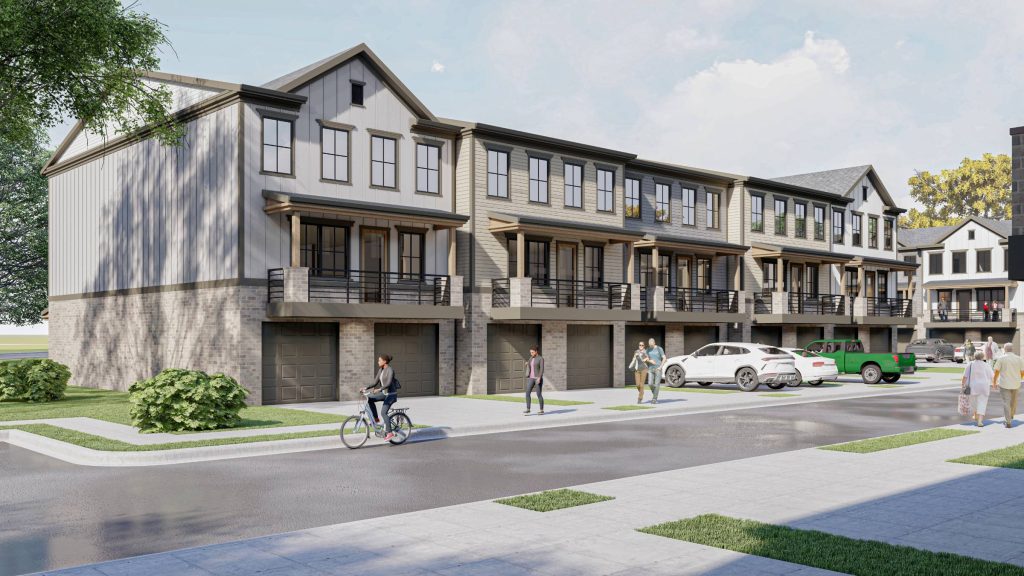
REV3 at Hill Road is a 120-unit BTR townhome community at 4975 Hill Road in Powder Springs. The project includes stacked townhomes, one-car garages, walking trails, greenspace, playground areas, and pet facilities.
Construction is underway. Leasing was scheduled to begin in the second quarter of 2026, with the first homes expected to deliver in the fourth quarter. Details are available on the REV3 Homes Hill Road page and in Urbanize Atlanta’s project coverage.
Powder Springs provides a standard BTR location profile. Land is less expensive than in many core submarkets, while access to Cobb County employment, the Silver Comet Trail, Hiram, Marietta, and Atlanta remains available. The principal risks are lease-up velocity, vehicle dependence, and competing new construction.
Newnan
Celebration Park in Newnan received zoning approval for 150 homes along Celebrate Life Parkway near Interstate 85. The plan includes:
- 114 rear-entry stacked townhomes.
- 36 front-entry ranch-style townhomes.
- A product segment directed partly toward active-adult renters.
- A pool, dog park, playground, and access to the LINC Trail.
Newnan has maintained a restrictive entitlement environment. The project demonstrates that approved zoning can create material value for landowners and builders. It also demonstrates the development risk that individual investors face when attempting to replicate the BTR model independently.
Lawrenceville
Harmon Cedar Run is a reported 151-unit BTR community in Lawrenceville. The project adds to the suburban Gwinnett pipeline and reflects continued institutional interest in second-ring Atlanta markets.
Lawrenceville benefits from access to Interstate 85 and State Route 316, established employment areas, schools, retail, and a large renter base. The underwriting issue is supply concentration. East Gwinnett and nearby areas remain among the Atlanta submarkets with significant construction activity.
Henry County
Henry County remains a major south metro development location. It has also experienced a substantial slowdown in apartment construction and new multifamily proposals. Local reporting has described apartment construction as reaching a seven-year low, while broader Atlanta data show a significant reduction in deliveries and units under construction.
Matthews reported that Henry County represented approximately 5.2% of existing apartment inventory under construction in the second quarter of 2026. Metro Atlanta completions fell to 2,703 units in the quarter, down 40.5% year over year. Vacancy was 5.86%, down from 6.45% in the first quarter but still elevated.
The market is transitioning from oversupply toward stabilization. Henry County rental vacancy was reported near 7.3%, while asking rents remained approximately flat. Investors should not assume immediate rent acceleration. The more reliable conclusion is that fewer future deliveries may support occupancy and rent growth after existing lease-up activity is absorbed.

Build-to-Rent and Traditional Rentals: The Main Differences
| Factor | Build-to-rent | Existing single-family rental |
|---|---|---|
| Property condition | New construction | Condition varies by age and maintenance |
| Tenant profile | Often family-oriented and suburban | Depends on neighborhood and property type |
| Operations | Standardized layouts and professional management | More individual property decisions |
| Maintenance | Lower initial repair exposure | Higher risk of deferred maintenance |
| Entry access | Usually through funds, syndications, or development partnerships | Direct purchase is commonly available |
| Pricing | Often priced at a premium for new construction | More pricing variation and negotiation potential |
| Risk | Development, lease-up, and concentration risk | Physical condition, vacancy, and repair risk |
| Exit options | Dependent on institutional and commercial buyers | Broader owner-occupant and investor buyer pool |
BTR may provide better operational consistency. Existing homes may provide more favorable acquisition pricing and stronger resale flexibility. Neither structure guarantees positive cash flow.
Atlanta Underwriting Example
A simple comparison illustrates the financing issue.
Assume an existing Atlanta-area single-family rental is purchased for $405,000. Assume the property generates $2,650 per month in rent, with a 25% down payment and a 30-year investment loan at an illustrative 7.25% interest rate.
Estimated monthly figures:
- Gross rent: $2,650.
- Vacancy and collection loss at 6%: minus $159.
- Property management at 8%: minus $212.
- Maintenance at 6%: minus $159.
- Property taxes: approximately $371.
- Insurance: approximately $180.
- Association and operating costs: approximately $100.
- Principal and interest: approximately $2,070.
The resulting cash flow is negative before capital expenditures and income taxes. This is an illustration, not a market projection. Actual taxes, insurance, financing, rent, and expenses must be verified for the specific property.
The example establishes a basic standard. A property purchased near the Atlanta median price may require one or more of the following to produce an acceptable return:
- A lower acquisition price.
- Higher verified rent.
- A larger down payment.
- Lower insurance and tax costs.
- Reduced renovation requirements.
- A value-add plan.
- More favorable financing.
- A longer hold period with a documented exit strategy.
BTR assets may have lower initial maintenance requirements, but new construction is frequently priced at a lower capitalization rate. The investor may pay more for predictable physical condition and standardized operations.
Decision Framework for Atlanta Investors
Choose an existing single-family rental when:
- Direct ownership is required.
- Acquisition pricing is below comparable replacement cost.
- The neighborhood has established resale demand.
- Current rent supports the debt structure.
- Repairs and capital expenditures are documented.
- The property can remain viable with flat rents.
Established areas of Cobb, Gwinnett, DeKalb, Clayton, and selected south and west Atlanta submarkets require property-level analysis. County averages are not sufficient.
Consider BTR exposure when:
- Professional management is preferred.
- Family-oriented suburban demand is the target.
- Lower initial maintenance risk has value.
- The investment can be made through a qualified fund, syndication, or partnership.
- The investment horizon is long term.
- Lease-up and development risks are understood.
BTR exposure should not be treated as equivalent to owning one rental home. Investors must review the operating agreement, fees, debt, distribution policy, sponsor experience, construction budget, lease-up assumptions, and exit provisions.
Buy lots or work with builders when:
- Development risk is acceptable.
- Entitlement and zoning work can be managed.
- Construction financing is available.
- A qualified Georgia builder is engaged.
- The project has a defined rental or sale exit.
- Adequate reserves are available for delays and cost increases.
Land underwriting must include purchase price, due diligence, zoning, utilities, roads, impact fees, engineering, permits, construction, interest carry, builder fees, insurance, taxes, marketing, lease-up, and contingency reserves.
Georgia Legal and Due Diligence Requirements
BTR and traditional rental transactions require different legal processes, but both require documented compliance.
For an existing rental, the buyer should complete inspections, title review, tax verification, insurance underwriting, lease review, and property management review during the contractual due diligence period. Closing is conducted through a Georgia closing attorney.
For a development site, the review should include:
- Current zoning classification.
- Rezoning or variance requirements.
- Local moratoriums.
- Comprehensive plan consistency.
- Sewer and water availability.
- Road access.
- Stormwater requirements.
- Environmental conditions.
- Development impact fees.
- Building permits.
- Builder contracts and draw procedures.
- Lien waivers and payment controls.
- Construction insurance.
- Completion guarantees.
- Homeowners association or community restrictions.
Georgia landlord-tenant requirements should be reviewed before leasing. The Georgia Department of Community Affairs landlord-tenant handbook provides state-specific information. Legal counsel should review leases, entity structures, management agreements, construction contracts, and development documents.
Appreciation Outlook in Outer Atlanta Submarkets
Outer suburban appreciation is likely to remain dependent on employment access, transportation infrastructure, household formation, school zones, and supply discipline.
Powder Springs, Newnan, Lawrenceville, and Henry County have land availability and renter demand. They also have longer commutes, greater dependence on vehicles, and more exposure to new construction competition.
The 2026 market does not support an underwriting strategy based only on rapid appreciation. The current market provides more inventory and more negotiation time. It does not eliminate interest-rate risk, vacancy risk, insurance risk, tax reassessment, construction risk, or local entitlement risk.
The required standard is direct. A BTR investment, an existing single-family rental, or a development lot should remain financially acceptable under conservative rent, vacancy, expense, and appreciation assumptions.
GPC Real Estate’s investment process and investor education resources provide additional information for evaluating Atlanta-area acquisitions.
Disclaimer: This article is provided for educational purposes only. It is not legal, tax, lending, appraisal, financial, or investment advice. Federal law, Georgia law, local ordinances, market data, and financing terms should be verified with qualified professionals before a transaction or investment decision.
