
Airbnb vs. Long-Term Rentals in Atlanta: The Real Numbers, and the Regulation That Could End the Trade
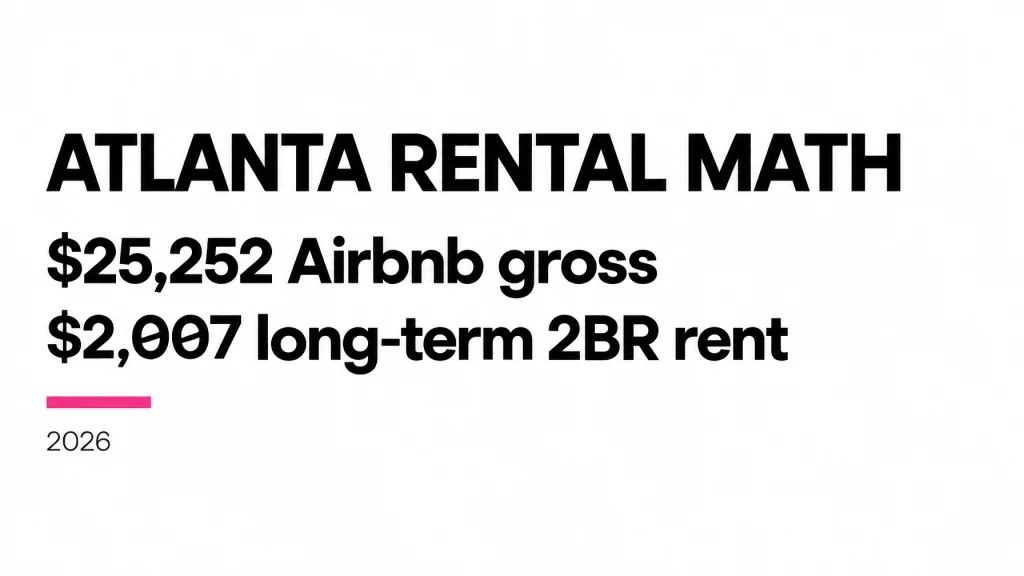
In Atlanta, an average short-term rental grossed $25,252 over 12 months, while the median advertised rent for a two-bedroom was $2,007 per month. On a monthly basis, that is about $2,104 versus $2,007 before operating expenses. The gross difference is narrow. After costs, seasonality, and licensing requirements, it does not establish that a short-term rental is the stronger investment.
A pending city proposal adds regulatory risk. As of October 27, 2026, it has not been enacted. If adopted, it would substantially restrict non-owner-occupied short-term rentals in Atlanta.
What the Average Atlanta Airbnb Actually Grosses
AirROI’s Atlanta, Georgia data cover October 2025 through September 2026, use active Airbnb listings, and report revenue per listing. The dataset was updated October 1, 2026. It counts 5,986 active listings, the largest of 209 Georgia markets tracked.
| Metric | Atlanta result |
|---|---|
| Average annual revenue per listing | $25,252 |
| Average monthly revenue, annual figure divided by 12 | About $2,104 |
| Occupancy, share of open nights booked | 37.1% |
| Average daily rate per booked night | $256 |
| Revenue per available night | $96 |
| Median listing revenue per month | About $2,330 |
| Bottom-quarter monthly revenue | $1,070 or less |
| Top-quarter monthly revenue | $4,190 or more |
The average annual revenue was about 16% below the Georgia average of $30,219. Occupancy was close to the Georgia average of about 38%, and below the U.S. average of 41%. Atlanta’s $256 average daily rate was below both the Georgia average of $290 and the U.S. average of $320. These are AirROI listing-level estimates for the same trailing 12-month period.
Revenue was uneven through the year. AirROI’s typical-month seasonal averages, excluding the unusual June and July 2026 results, put July at about $3,400 per listing and February at about $2,240. High season, May through July, averaged $3,250 per month at 44% occupancy and a $223 nightly rate. The low season, February and September, averaged $2,290 per month, 39% occupancy, and a $199 nightly rate.
June and July 2026 listings earned about 62% more than in the same months a year earlier. AirROI identifies those months as one-offs. The annual average includes them, so they should not be treated as a reliable recurring baseline.

The Running-Cost Wedge: What Is Left Before the Mortgage
AirROI estimates that operating costs consume about 24% of bookings, including platform fees, cleaning, utilities, supplies, upkeep, insurance, and permits. Its average-listing estimate leaves $16,012 per year, or about $1,330 per month, for housing costs. This is before mortgage or rent, property taxes, home insurance, and any HOA or condo fees.
| AirROI estimate, Atlanta listings, Oct. 2025–Sep. 2026 | Average listing | Top-quarter listing |
|---|---|---|
| Gross annual bookings | $25,252 | $45,440 |
| Estimated annual running costs | $9,240 | $16,310 |
| Left for housing costs | $16,012 | $29,130 |
| Monthly amount left before housing costs | About $1,330 | About $2,430 |
Cleaning fees require attention in any operating model. AirROI reports a $125 median fee and says about 89% of Atlanta listings charge one. Its profit estimate treats cleaning payments and cleaning costs as offsetting when a cleaner is hired. If the owner cleans the unit, the owner takes on the labor. AirROI estimates that a co-host charging 10% of nightly bookings reduces the average monthly amount left to about $1,150.
These figures are operating estimates, not property-level forecasts. Actual costs depend on the home, services, management arrangement, and booking pattern.
The Long-Term Baseline: What a 2BR Rents For Right Now
Zumper’s Atlanta rent research was last updated October 27, 2026. It uses advertised listings from a rolling 30-day period and calculates median rents across listings on its platform. Its figures are advertised rents, not achieved rents.
| Atlanta advertised rent | Zumper figure, October 27, 2026 |
|---|---|
| All beds, median | $2,000 per month |
| Two-bedroom, median | $2,007 per month |
| Studio | About $1,460 per month |
| One-bedroom | About $1,619 per month |
| House, median | $2,400 per month |
| Apartment, median | $1,773 per month |
Zumper reported citywide advertised rent growth of about 5.5% year over year. It listed 2,216 rentals on its platform and reported houses as 55.9% of its rental inventory. The result describes Zumper’s listings and methodology; other platforms can show different figures because their listing inventories and methods differ.
Head-to-Head: STR Revenue vs. Long-Term Rent on the Same Property
The average AirROI Airbnb grossed about $2,104 per month, roughly $97 more than Zumper’s $2,007 median advertised two-bedroom rent. Annualized, the difference is $1,168 before short-term rental operating costs. This is not a like-for-like comparison: one figure is average gross booking revenue per active listing, and the other is a median advertised rent for a bedroom category.
The distribution matters more than the average. AirROI reports that the median listing was booked on 38% of open nights. The top quarter reached 60% or more; the bottom quarter was booked on 19% or fewer. Top-quarter listings left about $2,430 per month before housing costs under AirROI’s operating estimate. The median listing left about $1,330. Bottom-quarter revenue was $1,070 or less per month, before expenses.
AirROI’s top-grossing Atlanta listing, a seven-bedroom home, earned about $356,000 over the year, around 14 times the city average. This is an exceptional listing, not a reasonable default for an acquisition model.
AirROI’s annual median revenue by home size also varies substantially:
| Home size | Median annual revenue |
|---|---|
| Studio | $13,000 |
| One bedroom | $15,700 |
| Two bedrooms | $17,300 |
| Three bedrooms | $23,700 |
| Four bedrooms | $37,800 |
| Five or more bedrooms | $62,200 |
These are Atlanta listing medians for October 2025 through September 2026, as reported by AirROI. Bedroom count alone does not establish revenue, expenses, licensing eligibility, or property-level performance.
The Regulatory Picture: Current Law vs. the Held Proposal
Atlanta’s current short-term rental law is Ordinance 20-O-1656, Part 20 of the City Code. The city’s Short-Term Rental licensing page describes the licensing process. The ordinance and city requirements include:
| Current requirement | Summary |
|---|---|
| License and fee | A short-term rental license is required. The annual fee is $150, and the license is valid for 12 months. |
| Eligible dwellings | One license covers the applicant’s primary residence plus one additional dwelling unit. |
| Application documents | Proof of primary residency, a valid Occupational Tax Certificate, $500,000 in liability insurance, and evidence of certified-mail notification to adjacent property owners are required. |
| Local contact | A designated agent must be available for 24-hour contact, noise monitoring, and emergency information. |
| Listing and occupancy | The STRL number must be stated on listings. Occupancy is limited to two adults per bedroom. |
| Violations | Three violations within 12 months can result in license revocation. |
| Neighborhood restriction | Home Park bans short-term rentals. |
| Taxes | AirROI’s October 2026 regulations summary estimates taxes at about 16.9% plus $5 per night. |
City Planning’s page also states that enforcement was extended but does not provide a start date. Requirements should be checked with the city before relying on a particular enforcement timeline.
Proposal 26-O-1084 is separate from current law. According to the City of Atlanta legislative record, it was held in the Community Development/Human Services Committee on September 21 and October 5, 2026, and appeared on the October 13 committee docket. It was not enacted as of October 27, 2026.
If enacted, the proposal would create an Office of Short-Term Rentals and a registry, require owner and operator permits, and require the rented home to be the resident’s primary residence. It would define a permanent resident as someone occupying the home at least 275 days per calendar year and limit unhosted rentals to 90 nights per year. Booking platforms would have to verify permits before listing or accepting bookings and recheck at least every 30 days. The proposal includes fines of $1,000 per day for platforms facilitating unverified or illegal listings.

Where This Leaves Absentee Investors
Current law already limits a license to a primary residence and one additional dwelling. A pure investor-owned portfolio of non-owner-occupied short-term rentals is therefore at the edge of what the city’s current licensing framework permits. Proposal 26-O-1084 would eliminate the additional-dwelling option if enacted.
AirROI found that only 9% of its 5,986 active Atlanta listings displayed a registration, permit, or license number. That is a listing-data signal about permit visibility. It does not establish that the other listings are unlicensed or unlawful.
Suburbs have separate rules and market conditions. AirROI reports average annual revenue of $29,401 in Brookhaven and $13,557 in Hapeville for its October 2025–September 2026 dataset. The difference reinforces the need to confirm municipal rules and property-level demand instead of applying Atlanta-wide figures across jurisdictions.
An Investor’s Decision Checklist
Before purchasing an investment property for sale for short-term use:
- Verify city, county, zoning, neighborhood, and HOA or condominium restrictions for the specific address.
- Model revenue using bottom-quartile occupancy and account for seasonality and turnover.
- Budget for the estimated 24% running-cost share, cleaning, management, and housing costs.
- Confirm current STRL requirements and check the status of pending ordinances before closing.
- Determine whether the property qualifies under current primary-residence rules.
- Confirm the applicable suburb’s short-term rental requirements.
- Compare against local long-term advertised rents, then account for vacancy, maintenance, management, and Georgia landlord-tenant requirements.
For additional Atlanta market updates and investor education, see GPC Real Estate’s Q4 2026 Atlanta rental market outlook, Georgia landlord-tenant law overview, and investment process.
Bottom Line
Atlanta’s average short-term rental gross is only slightly above the advertised median two-bedroom rent before operating costs. The actual revenue distribution is wide, and the proposed ordinance creates material regulatory uncertainty for investor-owned units. For most absentee investors, long-term rentals are the more durable base case. Short-term rentals require property-specific evidence of performance and clear regulatory eligibility.
Educational disclaimer: This article is for educational purposes only and is not legal, tax, lending, or investment advice. Data are estimates based on the cited sources, periods, and methodologies. Verify current requirements with Atlanta City Planning and consult qualified professionals before making decisions.

[…] post follows our Atlanta short-term versus long-term rental analysis. If proposed STR restrictions narrow the first lane and long-term rentals remain the baseline, […]