Forsyth County offers strong household incomes, highly ranked public schools, low published county and school millage rates, and long-term housing demand. Those factors support property values. They do not automatically produce positive rental cash flow. For 2026 investors, Cumming and the South Forsyth corridor are primarily appreciation and long-hold markets. Rental returns depend on purchase […]

The BRRRR Method in Atlanta 2026: Where the Refinance Math Still Works (and Where It Breaks)
BRRRR means Buy, Rehab, Rent, Refinance, Repeat. The strategy uses a renovation to increase a property’s value, then uses a refinance to recover some of the invested capital. In metro Atlanta in 2026, the method still works. The margin for error is narrower, and the refinance is often the make-or-break step. The relevant market trends […]
DSCR Loans in Georgia 2026: How Atlanta Investors Finance Rental Property Without W-2 Income
A debt service coverage ratio (DSCR) loan can help finance a Georgia rental property when the borrower’s personal income does not fit conventional underwriting. Qualification is based primarily on property income and debt obligations. Rates, required equity, and eligibility vary by lender and property. What Is a DSCR Loan and How Is It Calculated? A […]
Paulding County Real Estate in 2026: Do Dallas and Hiram Still Cash-Flow for Atlanta Rental Investors?
Market position in October 2026 Paulding County remains a moderate-growth rental market in the west Atlanta corridor. The market is no longer defined by rapid price escalation. Inventory is higher, marketing periods are longer, and asking prices require closer underwriting. The latest complete county report covers September 2026. It records: Median sale price of $355,000, […]
Section 8 Rental Investing in Atlanta 2026: Housing Choice Voucher Math, Inspections, and Where It Still Pays
Section 8 rental investing remains viable in selected Atlanta-area submarkets. The strategy depends on accurate payment-standard research, property condition, rent reasonableness, and purchase price. The Housing Choice Voucher program does not guarantee any asking rent. It also does not eliminate landlord responsibilities. The administering public housing agency must approve the tenant, rent, unit condition, lease, […]
How to Hold Atlanta Rental Property in 2026: LLC, Umbrella Insurance, or Your Own Name
Ownership structure affects liability exposure, financing, insurance, taxes, and administrative requirements. Georgia rental property may be titled in an individual’s name, a Georgia LLC, a qualified foreign LLC, or a trust arrangement. Each structure has different costs and operational requirements. This article provides investor education based on Georgia Real Estate Law & Process. It does […]
Peachtree City and Fayette County Real Estate in 2026: Does South Atlanta’s Master-Planned Market Still Cash-Flow for Rental Investors?
Market position in 2026 Peachtree City remains one of the highest-priced residential markets in Fayette County. The market is supported by established neighborhoods, strong public schools, employment access, and a master-planned layout with an extensive cart-path network. The market generally favors long-term appreciation, tenant stability, and property quality over immediate cash flow. A standard investment […]
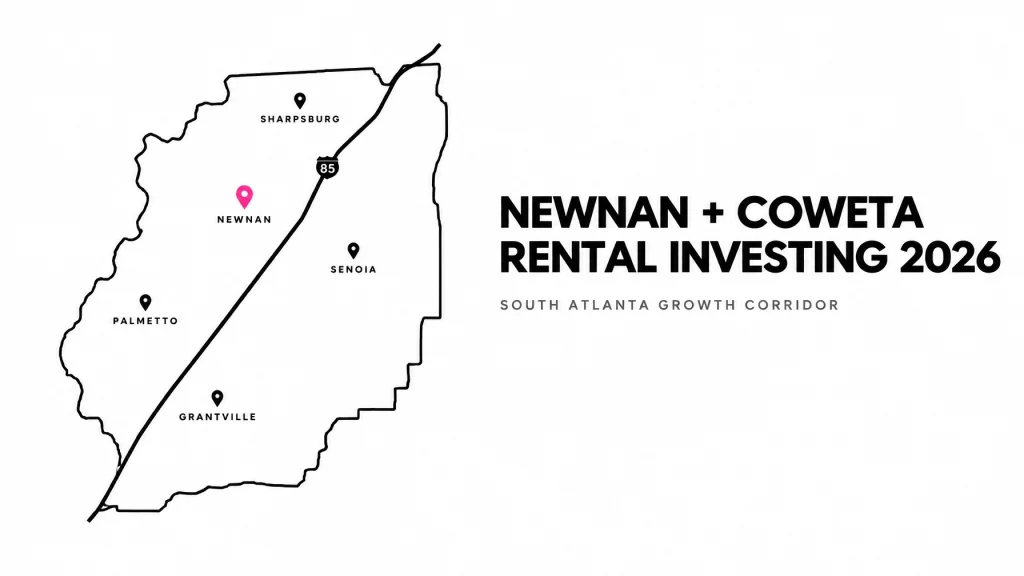
Newnan and Coweta County Real Estate in 2026: Does South Atlanta’s Growth Corridor Still Cash-Flow for Rental Investors?
Newnan and Coweta County remain active rental markets along the south Atlanta I-85 corridor. Population growth, school district demand, healthcare employment, industrial expansion, and access to Atlanta support long-term housing demand. The cash-flow calculation is less favorable. Acquisition prices have increased faster than rents in several submarkets. Taxes, insurance, management, maintenance, vacancy, and financing costs […]
Kennesaw and Acworth Real Estate in 2026: Does Cobb County’s Northwest Corridor Still Cash-Flow for Atlanta Rental Investors?
Kennesaw and Acworth remain active rental markets along Cobb County’s I-75 and I-575 northwest corridor. The 2026 market is balanced rather than distressed. Inventory has increased, marketing periods are longer than during the peak cycle, and rental demand remains supported by employment, schools, transportation access, and Kennesaw State University. The primary investment issue is pricing. […]
Atlanta Market Trends October 2026: Inventory, Days on Market, and How Investors Should Price Offers This Fall
Published October 2, 2026 Atlanta’s residential market is balanced to slightly buyer-favorable in fall 2026. Inventory is higher than during the recent seller-dominated period. Marketing times have increased. Sale-to-list ratios remain close to 100 percent, which limits the availability of deep discounts on well-priced properties. The latest available data is primarily from September 2026. October […]