
Iran War Freezes Spring Housing Market, Opens the Widest Wholesale Spread in Years

Rising oil prices, surging mortgage rates, and 42,000 collapsed contracts are sidelining retail buyers — but creating a rare acquisition window for investors who move on cash and speed.
Five weeks ago, the housing market was on the verge of its best spring season in three years. Mortgage rates had slipped below 6% for the first time since 2022. Buyer confidence was climbing. Inventory was loosening. Then the U.S. and Israel launched joint strikes on Iran on February 28 — and every one of those gains evaporated within days.
What’s unfolded since is a textbook case of geopolitical shock rippling through domestic real estate. Oil prices have surged past $110 a barrel. Inflation expectations have spiked. Treasury yields have climbed as investors dump bonds. And mortgage rates — which briefly touched 5.98% in late February — have now risen for five consecutive weeks to roughly 6.46%, their highest level since September 2025.
For traditional homebuyers, this is a devastating reversal. For real estate investors — particularly wholesalers who operate on cash and speed rather than financing — this is the widest acquisition window the market has offered in years. Here’s what’s actually happening beneath the headlines, and why it matters if you’re in the business of finding and moving distressed deals.
The Chain Reaction Most People Don’t See
The connection between a military conflict thousands of miles away and your local housing market isn’t obvious to most people. But it’s direct, and it’s mechanical. The Iran conflict disrupted the Strait of Hormuz — the narrow waterway that carries roughly 20% of the world’s oil supply. When that chokepoint closed, energy prices didn’t just rise. They spiked hard enough to reignite inflation fears that the Federal Reserve had spent two years trying to extinguish.
That matters because mortgage rates don’t follow the Fed’s benchmark rate — they follow the 10-year U.S. Treasury yield. And Treasury yields move on inflation expectations. When oil surges and investors fear that the cost of everything from gas to groceries to building materials is about to climb, they sell bonds. Yields rise. And mortgage rates go up right behind them.
The pipeline is simple: Iran conflict → Strait of Hormuz closure → oil spikes to $110+ → inflation fears reignite → investors sell bonds → 10-year Treasury yield climbs from 3.96% to 4.4%+ → mortgage rates jump from 5.98% to 6.46% in five weeks → retail buyers freeze → sellers get stuck → wholesale opportunity widens.
One senior economist at loanDepot put it plainly: without the geopolitical tensions, the 10-year Treasury would likely be well south of 4%, with mortgage rates sitting comfortably in the high 5s. The war didn’t just slow the housing market’s recovery — it reversed it at the worst possible moment, right at the front door of spring buying season.
The Retail Market Is Stalling in Real Time
The data from the last several weeks tells a story of a market that was gaining momentum and then hit a wall.
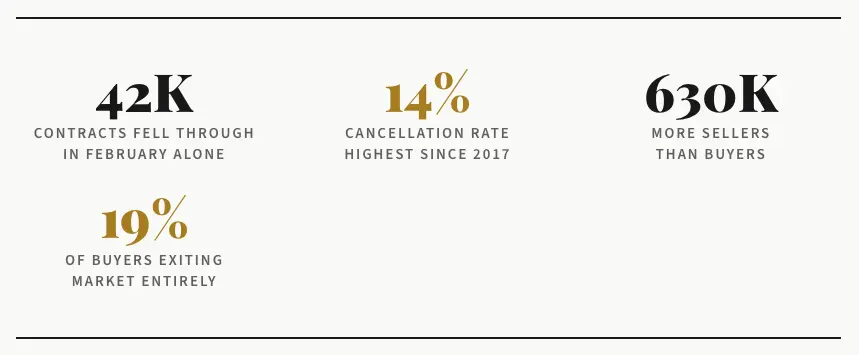
More than 42,000 homebuying contracts collapsed in February — nearly 14% of all homes that went under contract that month. That’s the highest cancellation rate for any February since Redfin started tracking the data in 2017. Buyers aren’t just hesitating. They’re walking away from deals they’ve already committed to.
According to a recent CNBC survey of real estate agents nationwide, about one-third of agents said the economy was their buyers’ primary concern, and another third cited mortgage rates — a significant jump from the end of last year. Only 9% of agents said home prices were the main issue, down from 18% the prior quarter. The fear has shifted from “homes cost too much” to “I don’t know what’s going to happen next.”
Nearly one in five agents reported that affordability concerns were pushing buyers out of the market entirely — up from 11% at the end of 2025. More than half of surveyed agents reported at least one contract cancellation in Q1. Homes are sitting longer, with 31% of agents reporting listings on market for more than six weeks, compared to 26% last quarter.
“Buyers that were on the fence and deciding to buy are now on the fence and going the other direction, saying, ‘I’m not going to buy.'”
— Eric Bramlett, Real Estate Agent, Austin, TX (via CNBC Housing Survey)
Meanwhile, there are now 630,000 more home sellers than buyers — the biggest gap in at least a decade according to Redfin. Some sellers who had planned to list in May have already pulled back, opting to wait until fall. The spring selling season that everyone was counting on hasn’t arrived. It’s been postponed by a war most Americans are still trying to understand.
Why This Creates a Wholesale Opportunity — Not a Crisis
Here’s where the perspective shifts. Everything I just described — rising rates, frozen buyers, collapsing contracts, desperate sellers — sounds like bad news if you’re a retail participant in the housing market. If you’re waiting for the “perfect time” to buy your first home with a 30-year fixed mortgage, this is a tough environment. No question.
But if you’re an investor — and especially if you’re a wholesaler who connects distressed sellers with cash buyers — this is exactly the market condition that creates the widest spreads between acquisition price and after-repair value.
Here’s the math behind the opportunity
Cash buyers don’t care about mortgage rates. The investors on my buyers list aren’t financing their acquisitions at 6.46%. They’re buying with cash, renovating, and either holding for rental income or selling into the eventual recovery. The rate environment is irrelevant to their purchasing power — but it’s everything to the motivated sellers who can’t find retail buyers anymore.
Seller expectations are resetting in real time. When the market was heating up earlier this year, sellers in distress still expected near-retail offers. That’s human nature — you anchor to the last number you heard. But five weeks of rising rates, collapsing contracts, and headlines about war and inflation have reset those expectations. Sellers who need to move — whether due to pre-foreclosure, divorce, inherited properties, or job relocation — are now far more realistic about what they’ll accept. That gap between what they’ll take and what my end buyers will pay is where the wholesale assignment fee lives.
Speed and certainty have never been more valuable. In a market where 14% of contracts are falling apart and buyers are backing out after inspections, a wholesaler who can offer a clean, fast, as-is cash close isn’t just convenient — they’re the only viable exit for many sellers. We solve a problem that the traditional market literally cannot solve right now.
“When retail buyers pull back, the deals don’t disappear. They move off-market — into the wholesale pipeline where sellers trade top dollar for speed and certainty.”
— Kevin Kao
What I’m Watching Over the Next 60 Days
The March CPI report drops this week. Economists expect it to show inflation running around 3% annually, driven heavily by the oil spike. If it comes in hot, the Fed will have even less room to cut rates — which means mortgage rates stay elevated and the retail freeze continues. That extends the wholesale window.
Trump’s 48-hour ultimatum to Iran expired today. Whether this leads to escalation or a ceasefire will determine whether oil pulls back or pushes higher. A ceasefire would eventually bring rates down, but the damage to spring buying season is already done. Even if peace breaks out tomorrow, the uncertainty hangover will keep retail buyers cautious for months.
The wall of maturities is still coming. Beyond the Iran situation, roughly $930 billion in commercial real estate loans mature this year, with at least $126 billion considered distressed. These are loans originated at 3-4% that are coming due in a 6-7% rate environment. That pressure will trickle down to small landlords, multi-family owners, and individual property holders — all potential motivated sellers in the wholesale pipeline.
Foreclosure filings are trending up. Over 100,000 properties filed for foreclosure in Q2 2025, a 13% year-over-year increase. This isn’t 2008. Distressed sales still represent only about 2% of total transactions. But the trend is directional — and for wholesalers, even a modest uptick in pre-foreclosure activity creates meaningful deal flow.
The Bottom Line
The war in Iran didn’t create a housing crisis. It exposed and accelerated one that was already simmering — an affordability problem built on years of elevated rates, tight supply, and wages that haven’t kept pace with home prices. What the conflict did was remove the one thing the spring market needed most: stability.
For retail buyers, the message is patience. Rates will eventually normalize. The market will rebalance. But the timeline just got pushed back.
For investors — for the people I work with every day — the message is different. This is a window. Motivated sellers are multiplying. Retail competition is thinning. Cash and speed are the two most valuable currencies in the market right now. And the spread between distressed acquisition price and after-repair value hasn’t been this wide since before the pandemic run-up.
The question isn’t whether opportunity exists. It’s whether you’re positioned to move on it before conditions shift again.
